Drain Unblocking
Blocked drain clearance 24/7 — toilets, sinks, manholes and outdoor drains, cleared on the first visit in the vast majority of cases.
Find out more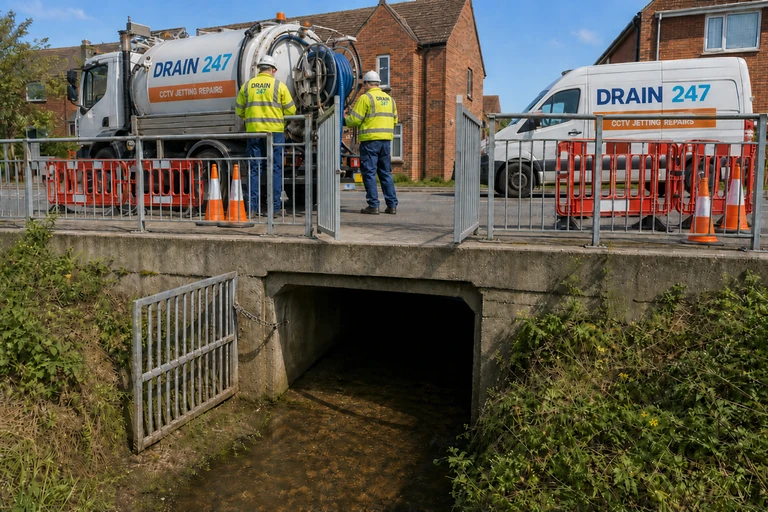
A culvert is the large-diameter pipe, box or brick arch that carries a watercourse under a road, driveway, railway or field access. Its job is to pass surface water without flooding the land above it or washing out the structure. When silt, roots or a cracked barrel stop that flow, the first sign is a garden, carriageway or field that used to drain overnight and now sits under water.
People search culvert cleaning, culvert inspection and culvert repair as if they were three different firms. They are one job on the same asset. We inspect with a crawler camera so we know whether the problem is silt, vegetation or a structural failure. We clean with high-volume jetting and tanker extraction so the barrel is actually empty, not just punched through. And we repair and rehabilitate the structure — lining, patching or replacing the section that has lost its integrity — rather than promising a flush will fix a collapse.
A robotic crawler camera so the price is for silt, roots or a collapsed barrel — not a guess from the bank.
JetVac tankers and high-volume jetting for large-diameter runs. A van jetter is not a culvert clean.
CIPP lining and patch repairs restore integrity where the barrel can take a liner. We excavate only when lining will not do.
Registered waste carrier. Arisings leave site with the paperwork a landowner or authority actually needs.
Domestic outfalls, estate roads, land-drainage culverts and local-authority runs across Hertfordshire.
A real person answers at three in the morning. If the carriageway or yard is under water, say so and we will tell you what can be there.
Culvert cleaning, CCTV inspection and a structural repair quote — booked now, so the next storm has somewhere to go.
We survey first with a crawler camera where the diameter allows, then jet, grab or mechanically remove the silt and debris. If the barrel is cracked, deformed or collapsed we will show you the footage and quote a lining or excavation repair rather than charging you for a clean that cannot restore the structure.
Call with the address and what you are seeing after rain. We quote a fixed price before plant arrives. Silt is taken away, not flushed into the next landowner’s ditch.
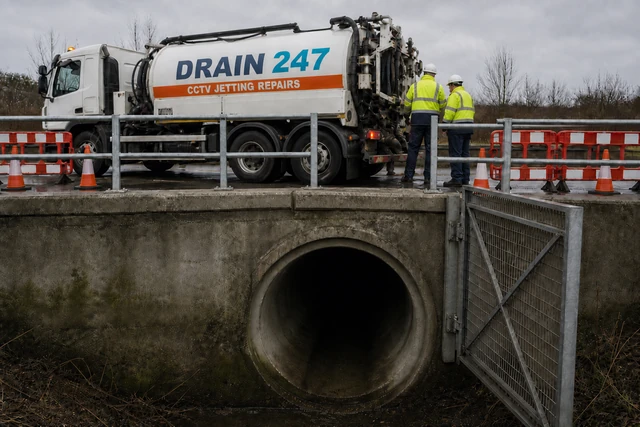
Cleaning, inspection and structural rehabilitation sit on one visit where the site allows. We do not sell a flush if the camera shows a collapse.
A robotic crawler through the barrel — from smaller culverts up to large-diameter runs — so we can see silt depth, joints, cracks, deformation and whether the invert is still there.
High-volume jetting to scour silt, gravel and scale from the wall — not a domestic jetter stretched past its job.
Vacuum tanker extraction so the arisings leave site. Flushing them downstream is not a clean.
Mechanical cutting where vegetation has taken the inlet, the joints or the barrel. A lined pipe still needs the roots out first.
CIPP lining, localised patches and, where lining cannot restore integrity, excavation of the failed length. The camera is the specification.
Footage and a written note of remaining defects — useful if a neighbour, insurer or authority later disputes the cause of flooding.
A culvert inspection is not a look from the bank, and it is not a man with a handheld camera. We send a robotic crawler into the barrel — tractor units that cover smaller culverts through to large-diameter runs — and record the invert, the joints, the crown and any deformation. That footage is what tells you whether you need a clean, a structural repair, or both.
What we are looking for is silt depth, root ingress, displaced joints, cracking, loss of invert, corrosion on corrugated steel, and whether the structure is still round or has started to flatten. A clean on a barrel that has already lost its shape is money spent twice.
You get the footage and a written condition note. If the run is a smaller private drain rather than a culvert, the same visit is a CCTV drain survey and we will say so rather than dressing a domestic pipe up as highway work.
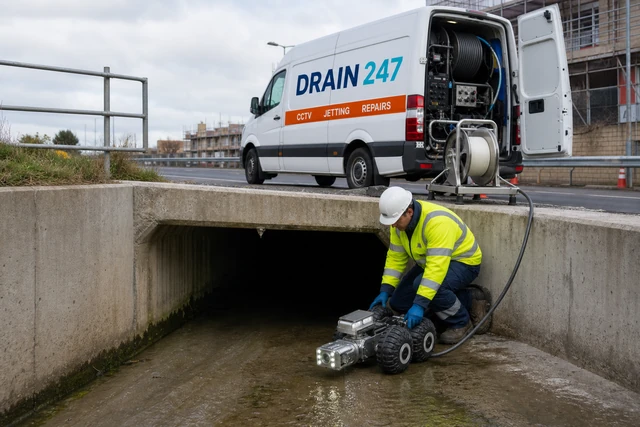
Cleaning restores flow. It does not put the structure back. If the barrel is cracked, fractured, deformed or the invert has gone, the culvert needs a repair that restores structural integrity — otherwise the next storm opens the same hole.
Where the diameter and condition allow, we rehabilitate from the inside. CIPP lining (cured-in-place pipe) forms a new structural wall inside the old one. Patch liners cover a local crack, hole or joint without lining the full length. Both are trenchless: the road, driveway or field access stays in place while the liner cures. The same methods we use on drain repair, scaled to a large-diameter run.
We only recommend excavation when lining cannot restore the barrel — a total collapse, a badly displaced joint, or a section we cannot access from either end. When we do dig, we show you the camera footage that explains why, and we quote the work before a shovel goes in the ground.
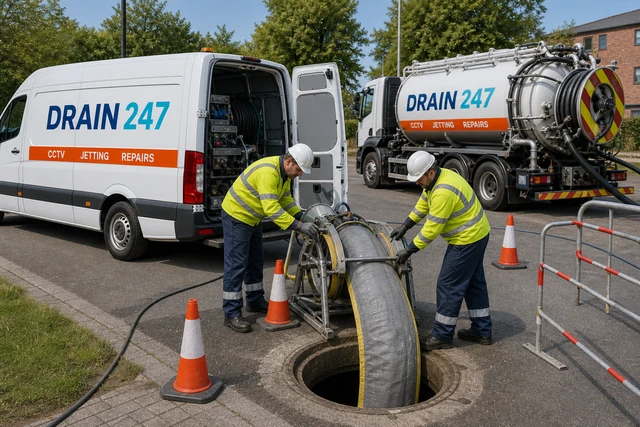
Brick, concrete, corrugated steel and plastic all fail in different ways. The camera tells us which, before anyone prices a method that will not fit the material.
Circular concrete, clay or plastic barrels under drives, farm tracks and estate roads. Common on private land around Watford.
Rectangular concrete sections under wider crossings. Silt sits in the corners; joints open; the invert wears first.
Brick and stone arches on older Hertfordshire roads and watercourses. Mortar loss, deformed rings and a missing invert are the usual defects.
Galvanised multi-plate and pipe-arch. Corrosion at the waterline and flattening of the crown are why we inspect before we jet.
Larger spans carrying a stream under an access. Inlet debris and downstream scour are as much the job as the barrel itself.
The large-diameter run off a garden, yard or development into a ditch. Often mistaken for a “blocked drain” until someone looks at the outfall.
Inspect, clean, then repair if the structure needs it. We do not skip the camera to get a tanker on site faster.
Crawler or push-rod CCTV from the ends we can reach. That shows silt, roots, cracks and whether lining is still possible.
High-volume jetting and tanker extraction. Roots and debris are cut out so a liner, if needed, can bond to the wall.
CIPP lining, a patch, or excavation of the length that cannot be saved. Quoted from the footage, before work starts.
After-camera footage and a written note of remaining defects, so you can show an insurer, neighbour or authority what was done.
A garden or driveway that floods after rain that used to disappear. Often the outfall or the culvert under the access, not the indoor drains.
Field accesses, land-drainage outfalls and estate roads. Plant that can work off a track, not a van that cannot leave the tarmac.
Scheduled inspection, cleaning and repair of private or adopted runs, with footage and waste-transfer paperwork for the file.
A silted or damaged culvert on a site that has to drain before the next inspection. Survey, clean and repair quoted as one conversation.
A silted or cracked culvert is often why a garden or carriageway floods in the first heavy rain. We can inspect, clean and quote a structural repair on the same visit.
Brilliant service, they helped unblock my drain really quickly. Would definitely recommend!
An absolute pleasure to deal with. George arrived at my house quickly to take care of a blockage in my drain. He cleared it in less than an hour and was very knowledgeable.
Drain 247’s mapping saved our project from delays. Clear plans, fast service.
Blocked drain clearance 24/7 — toilets, sinks, manholes and outdoor drains, cleared on the first visit in the vast majority of cases.
Find out more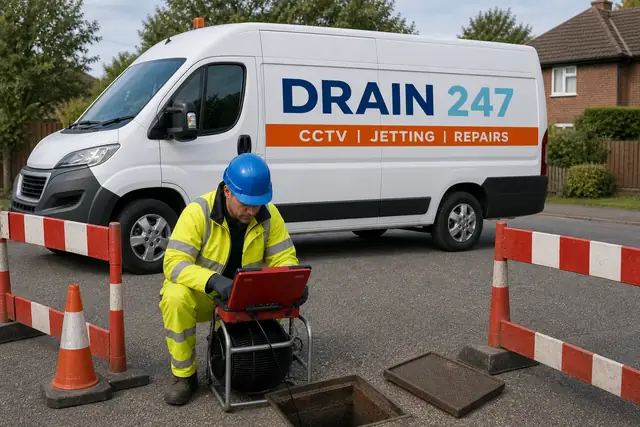
Camera inspections for homes, small businesses and small sites — footage and a written report you can act on.
Find out more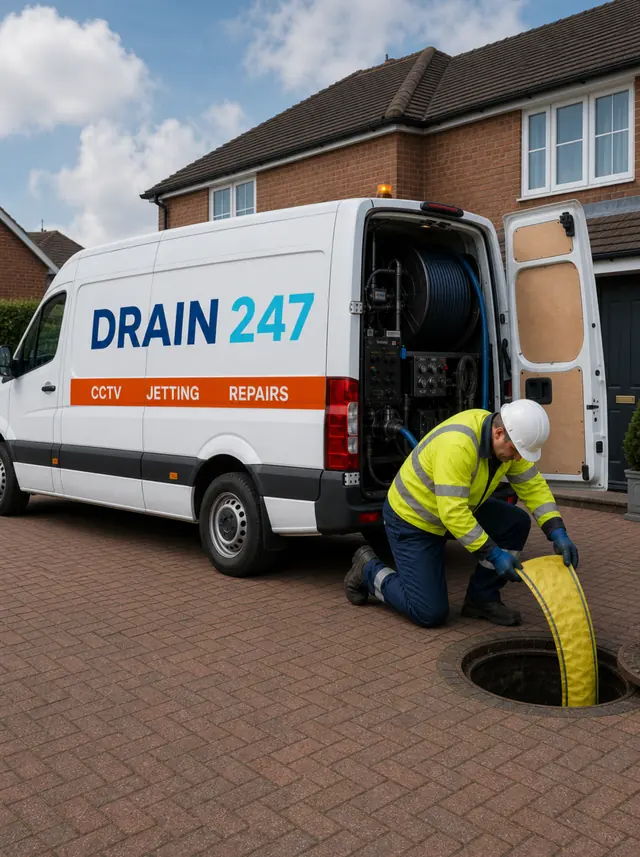
Patch lining, CIPP lining and gully excavation — cracked and collapsed drains repaired, no-dig first.
Find out more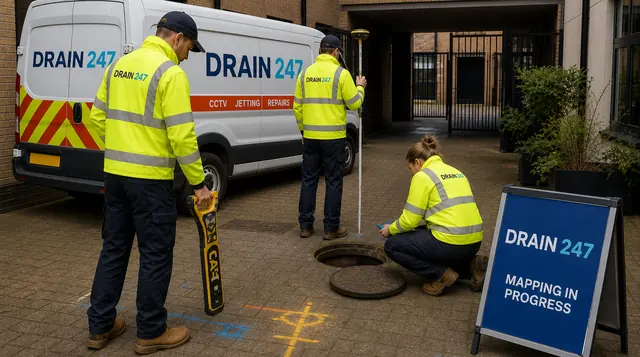
Drain mapping for architects, builders and homeowners — scaled plans, invert levels and connections before you apply.
Find out more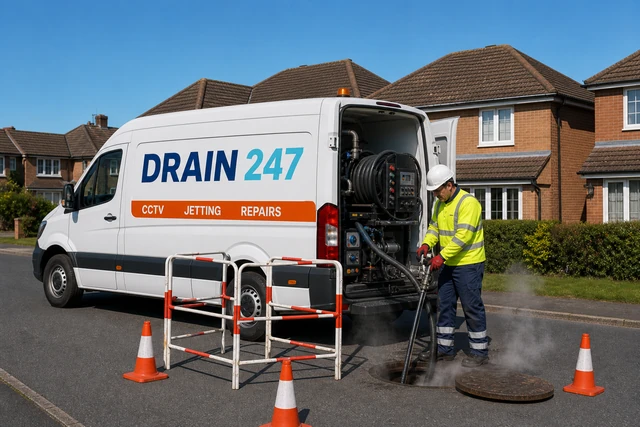
High-pressure water jetting that scours fat, silt and scale off the pipe wall — not a hole punched through it.
Find out more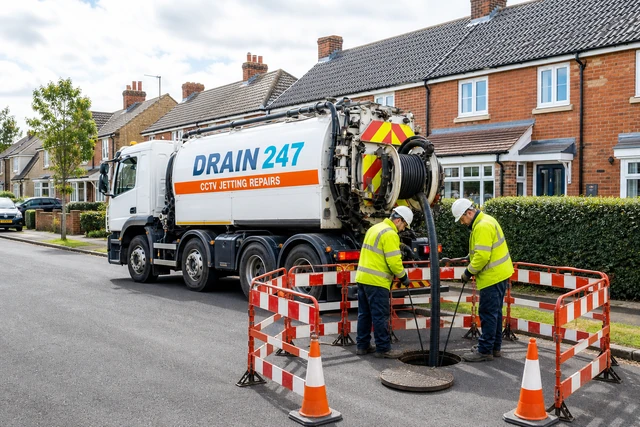
Vacuum tanker deployment for emptying, interceptors, and jobs too large for a van-mounted unit.
Find out moreBased in Watford. Culvert cleaning, inspection and repair across Hertfordshire and north west London.
A culvert is a drain, pipe, box or brick arch that carries a watercourse under a road, driveway, railway or field access. Its purpose is to pass surface water without flooding the land above it or eroding the structure. If that barrel silts up or fails, the water has nowhere to go.
If surface water used to clear and now ponds after ordinary rain, the outfall is the first place to look. A camera survey tells you whether it is silt, a collapse, or something downstream that is not yours.
Diameter, volume and access. A culvert is a large-diameter structure carrying a watercourse, not a 100mm house drain. It needs high-volume jetting, tanker extraction and often a crawler camera, not a van jetter and a plunger. If the run is actually a domestic drain we will say so and quote drain jetting or unblocking instead.
Yes. Culvert inspection is the first part of the job. We camera the barrel so we know whether we are looking at silt, roots or a structural failure, and we will not quote a clean as a cure if the footage shows a collapse. The same kit is used on a CCTV drain survey where the run is a smaller private pipe.
Often, yes. CIPP lining and patch liners rehabilitate cracked, fractured or leaking barrels from the inside, so the carriageway, driveway or field access stays in place. We only excavate when lining cannot restore the structure, and we show you the footage that explains why.
Where the barrel can take a liner, yes. A correctly installed CIPP liner is a structural pipe in its own right: it restores the wall, seals joints and gives the invert back. A total collapse, a badly displaced section, or a length we cannot access still needs excavation. We quote that separately rather than lining a hole that is no longer a pipe.
Pipe, box, brick-arch, masonry, corrugated steel and private outfalls — under drives, farm tracks, estate roads and watercourses. The material decides the repair. Corrugated steel that has lost its invert is a different job from a silted concrete pipe.
Yes, provided we can access both ends or a chamber. Trenchless lining is how we avoid breaking the surface. We will not recommend excavation through a carriageway until the camera has shown that lining or a clean will not do.
Yes. Flushing it into the next landowner’s ditch is not a clean. Arisings are removed and disposed of as a registered waste carrier, with the paperwork that goes with that.
We quote a fixed price before we start, from what the camera shows and how much plant the diameter needs. There is no call-out fee. A silted private outfall is a different price from lining a collapsed barrel under a road, which is why we will not price it from a photograph of the inlet alone.
We inspect, clean and structurally repair large-diameter runs and culverts for homeowners, farms, estates and local authorities.