May 5, 2024
How to Identify Your Property's Drainage Type (Foul vs. Surface vs. Combined)
Avoid accidental misconnections and know which pipes you are responsible for.
Most homeowners only ask “What drain is this?” when they are facing a problem. Perhaps you are planning an extension, buying a new house, or you are worried about a recurring blockage.
Identifying your system incorrectly can be expensive.
The Legal Risk: Connecting a washing machine to a surface water drain (rainwater) causes pollution and can lead to unlimited fines.
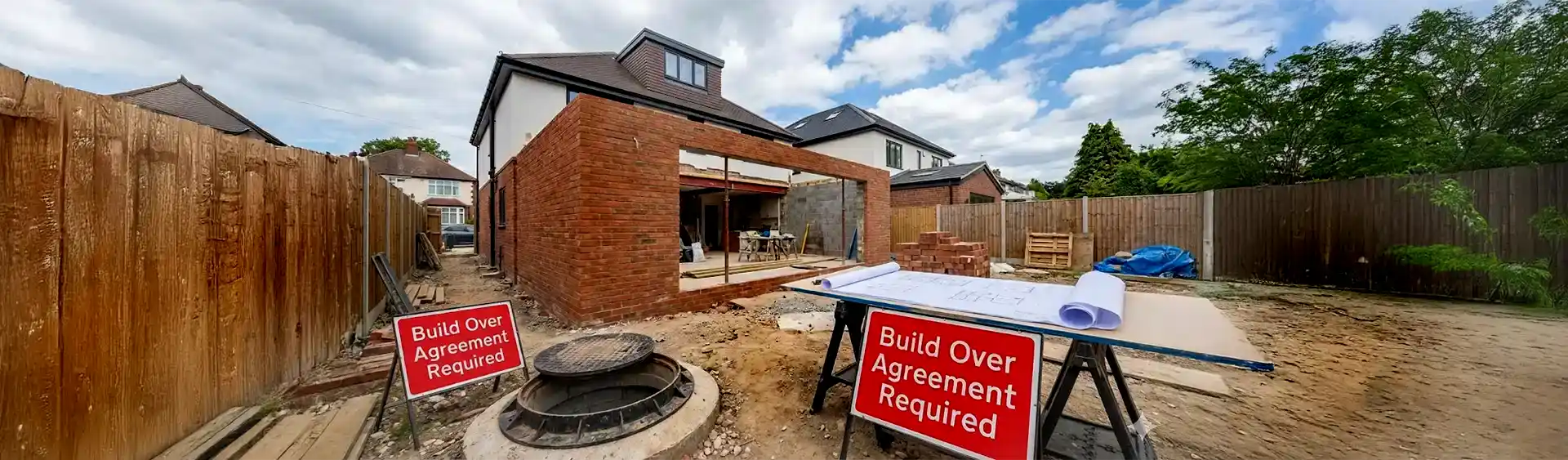
The Building Risk: If you build an extension over a public sewer without permission, the water company can force you to demolish it.
The Financial Risk: If you pay to unblock a “shared” pipe that actually belongs to the utility company, you have wasted your money.
The 3 Types of Systems
Planning an extension or buying a home? Don't guess—know for sure.
1. Surface Water Systems (Rain Only)
Function: Carries rainwater from roofs, gutters, and driveways to a local river or soakaway.
Visual Clue: Open gullies, downpipes, or grid covers on the driveway.
Important: You must never discharge dirty water (sinks, showers, washing machines) into these.
2. Foul Water Systems (Wastewater)
Function: Carries “dirty” water from toilets, kitchens, and bathrooms to the sewage treatment plant.
Visual Clue: Usually sealed manhole covers to prevent smells.
Important: These are the pipes that typically clog with fat, grease, and wet wipes.
3. Combined Systems (The “Victorian” Model)
Function: A single pipe carries both rainwater and sewage.
Where found: Very common in older properties across London and the South East.
Risk: heavy rain can cause sewage to back up into your garden (hydraulic overload).
The "DIY vs. Pro" Pivot
"Can I Just Lift the Manhole Cover and Look?"
You can try, but it is rarely accurate. A manhole often has multiple inlets hidden under the benching, or pipes that curve out of sight. Pouring dyed water down a sink and running outside to watch the manhole is the old-fashioned way, but it doesn’t tell you:
Where the pipe runs underground.
If there are “blind” connections you can’t see.
If the pipe is shared with a neighbour.
The Solution: Professional Drain Tracing & Locating If you need 100% certainty, we offer a System Verification Service. Using Sonar tracing equipment and specialised cameras, we can:
- Trace the line: Show you exactly where the pipe runs under your garden or floor.
- Verify connections: Confirm exactly which toilet flows into which pipe.
- Spot Shared Drains: Prove if a pipe serves your neighbour too (which changes who pays for repairs).
Who Pays?
One of the main reasons our customers ask “What system is this?” is to find out if they have to pay for a repair.
Private Drains: You are responsible for pipes that serve only your property, up to the boundary.
Lateral Drains & Public Sewers: If a pipe serves you and a neighbour (even if it’s on your land), or sits outside your boundary, it is usually the Water Company’s responsibility.
Don’t Pay for Someone Else’s Pipe. Before you pay for expensive repairs, let us perform a drainage layout check. If we prove the pipe is a public asset, you could save thousands in excavation costs.
Which Check Do You Need?
| Scenario | What You Need |
| “I’m planning an extension” | Drainage Layout Trace. We locate the pipes so your architect can draw accurate plans. |
| “I’m buying a house” | Home Buyer’s Pipe Inspection. We check the condition and layout before you exchange contracts. |
| “I have a blockage” | Standard Clearance. We identify the system type while clearing the blockage. |
Get Certainty About Your Pipework
Whether you need to trace a hidden pipe, check for a soakaway, or simply know who is responsible for a repair, Drain 247 has the technology to give you the answer.
Non-Invasive Tracing (No digging required).
Fast Appointments in London & Herts.
Clear, Jargon-Free Reports.