
Planning a Home Extension in Hertfordshire? What You Need to Know About Pipe Location & Build-Over Agreements
Hertfordshire is currently experiencing an extension boom. With moving costs so high, families across Watford, St Albans, and Hemel Hempstead are choosing to extend their kitchens, add wraparound extensions, or construct modern garden offices instead of moving house.
However, many homeowners and builders get so caught up in architectural designs and planning permission that they completely forget about what is hiding right beneath the ground: The drainage network.
If you are planning to dig foundations for an extension, you need to understand the rules regarding Water Authority Build-Over Agreements. Failing to handle this early can result in building control refusing to sign off your work, massive fines, or in extreme cases, being legally forced to tear down your new extension.
The 3-Meter Rule: When Do You Need an Agreement?
By law (under Building Regulations Document H4), you must obtain formal approval from your regional water authority if your proposed building work or new foundations are within:
-
3 meters of a public sewer.
-
1 meter of a public lateral drain (the pipe that connects your house to the main street sewer).
Remember, even if a drain sits entirely inside your private back garden, if it carries wastewater from your neighbor’s house as well as yours, it is classified as a public shared sewer.
What Happens If You Skip It?
-
No Building Sign-Off: Your local Council Building Control officer (whether in Watford, St Albans, or Dacorum) will ask to see your water authority approval. Without it, they will not issue your final Completion Certificate.
-
Issues Selling Your Home: When you eventually come to sell your house, the buyer’s solicitor will spot that the extension was built over a drain without an agreement, completely stalling or ruining the sale.
-
The Absolute Worst-Case Scenario: The Water Authority retains statutory legal powers to access their pipes. If an emergency occurs and your extension blocks their access, they have the legal right to alter or remove the structure to reach the pipe.
How to Secure Your Build-Over Approval (the 3 Steps)
Step 1: Locate and Trace the Drains Accurately: You cannot rely on old property maps—they are rarely accurate. Before an architect draws up your foundation layout, you need to know exactly where the pipes run, what direction they flow, and how deep they are buried.
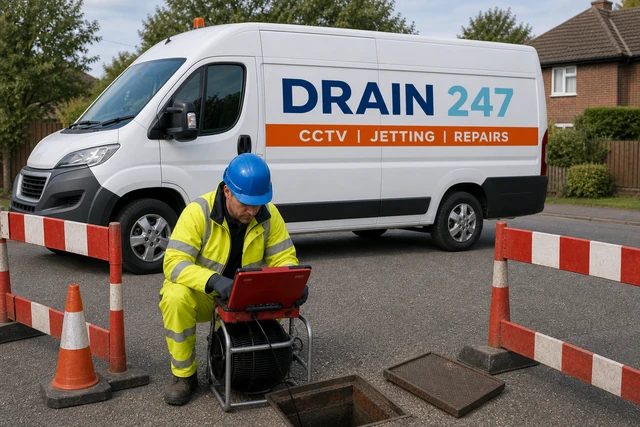
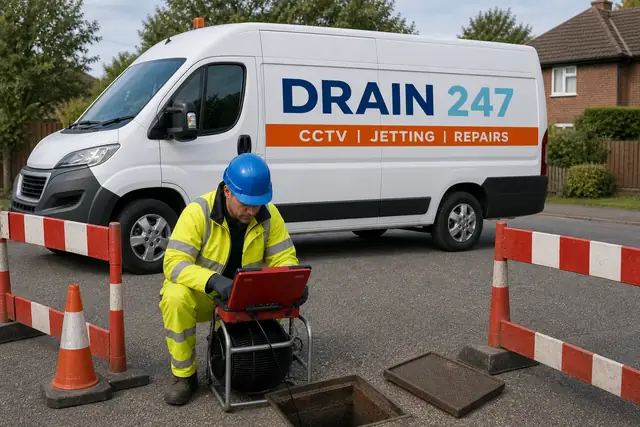
How we help: Our Watford-based team carries out specialized pre-construction CCTV Drain Surveys. We use advanced sonde tracing equipment to find the exact path and depth of the pipes, giving your architect the exact data they need for their drawings.
Step 2: The Pre-Construction Condition Check: The Water Authority will want proof that their pipes aren’t already damaged before your builders arrive. If the pipe is over 160mm in diameter, a professional CCTV camera survey is mandatory to record the internal structural integrity of the line.
Step 3: Apply for the Agreement: Using your drain layout sketches and architectural plans, you apply to the water authority. In many domestic cases where the drain is small, you can apply for a quick self-certified agreement online. For larger pipelines, a full structural evaluation is required.
The Essential Pre- & Post-Construction Surveys Explained
To get a Build-Over Agreement approved, water authorities don’t just take your word that the pipes are fine. They require absolute, verifiable proof. This is where a strict two-part testing protocol comes in: the Pre-Construction Survey and the Post-Construction Survey.
Part 1: the Pre-Construction Condition Check (Before You Dig)
- Before your builders touch a spade or bring an excavator onto your driveway, a professional CCTV drain inspection must be conducted. This serves two vital purposes:
- Locating and Tracing the Path: Old property deeds and water authority maps are notoriously inaccurate—sometimes off by several meters. We feed an advanced radio-frequency transmitter (sonde) down the pipe and track it from the surface using a digital receiver. This allows us to mark out the exact path, depth, and invert levels (the lowest internal point of the pipe) right onto your ground surface. Your architect needs this exact data so they can design foundations that bridge over the pipe rather than crushing it.
- Proving Prior Condition: We navigate an HD camera through the system to generate a certified WinCan report (the industry standard recognized by all UK water authorities). This report proves the structural state of the pipe before work begins. If there are already minor cracks or root issues, you can patch them via no-dig lining first. Crucially, it creates a legal baseline proving your project didn’t cause any pre-existing damage.
Part 2: the Post-Construction Sign-Off Survey (After the Build)
Once the extension is built, the heavy concrete is poured, and the structural steel is in place, we return to your property to run the camera through the exact same section of pipework a second time.
Why is this step non-negotiable for building control?
-
Checking for Structural Compression: The immense weight of a new brick extension or garden room foundations puts massive localized pressure on the surrounding ground. A post-construction survey verifies that the weight hasn’t caused the underground pipe to crack, squash, or misalign.
-
Catching Builder Mistakes: It is incredibly common for loose mortar, aggregate, or stray foundation concrete to accidentally drop down an open inspection chamber during a build. The final CCTV check ensures the line is completely clear, pristine, and flowing perfectly.
-
Your Legal Shield against Contractors: If the water authority checks the pipe later and claims it’s broken, your pre- and post-construction survey reports prove exactly whether your builders were at fault or if the issue lies elsewhere, saving you from a potentially massive legal or repair bill.
Getting It Right from Day One
To make sure your home improvement project runs seamlessly without hitting sudden structural roadblocks, follow this essential checklist the moment you start planning:
-
Talk to Your Architect Early: Ensure your design team is factoring in the underground pipe layout before they finalize your floor plans. Bridging a pipe with a concrete lintel is easy during design; it’s an absolute nightmare once the trench is already dug.
-
Don’t Assume Your Pipe is Private: If you live in a terraced or semi-detached house in areas like Bushey, Chorleywood, or Borehamwood, assume your drains are shared until proven otherwise.
-
Locate All Hidden Access Points: Ensure your design does not bury an existing manhole chamber inside your new kitchen or living room. If a manhole sits inside your extension’s footprint, it must legally be moved outside the building or converted using a double-sealed, airtight internal recessed cover.
-
Book Your Pre-Build Survey Before the Builders Arrive: Don’t wait for the contractors to turn up on your doorstep to think about the drains. Booking your pre-construction survey weeks in advance keeps your timeline perfectly on track.
Secure Your Extension’s Foundations Today: Don’t leave your drainage layout to guesswork or wait for a structural engineer to flag a compliance issue at the final hour.
If you are planning a project anywhere across Hertfordshire, contact Drain 247 today. We can provide a comprehensive pre-build CCTV survey and layout report to ensure your extension gets approved seamlessly FreePhone 0208 387 5591