Soakaway vs French Drain: Which Is Best for Heavy Clay Soil in Hertfordshire?
If your garden turns into a waterlogged swamp every time heavy rain hits Hertfordshire, you are likely deciding between two popular land drainage solutions: a soakaway or a French drain. Both systems manage surface water. The wrong one for the ground under the lawn is an expensive failure.
In Watford, St Albans and much of south-west Hertfordshire, the deciding factor is the heavy local clay, not the shape of the garden. And it matters more than it used to: the Met Office says the UK's most recent decade has been 3% wetter than 1991–2020, and 13% wetter than 1961–1990, and the Environment Agency estimates that 4.6 million properties in England are in areas at risk of flooding from surface water.
How Each System Works
A soakaway is an underground storage matrix, usually geo-cellular crates wrapped in geotextile. It collects surface water, holds it during a storm, and lets it seep into the surrounding ground.
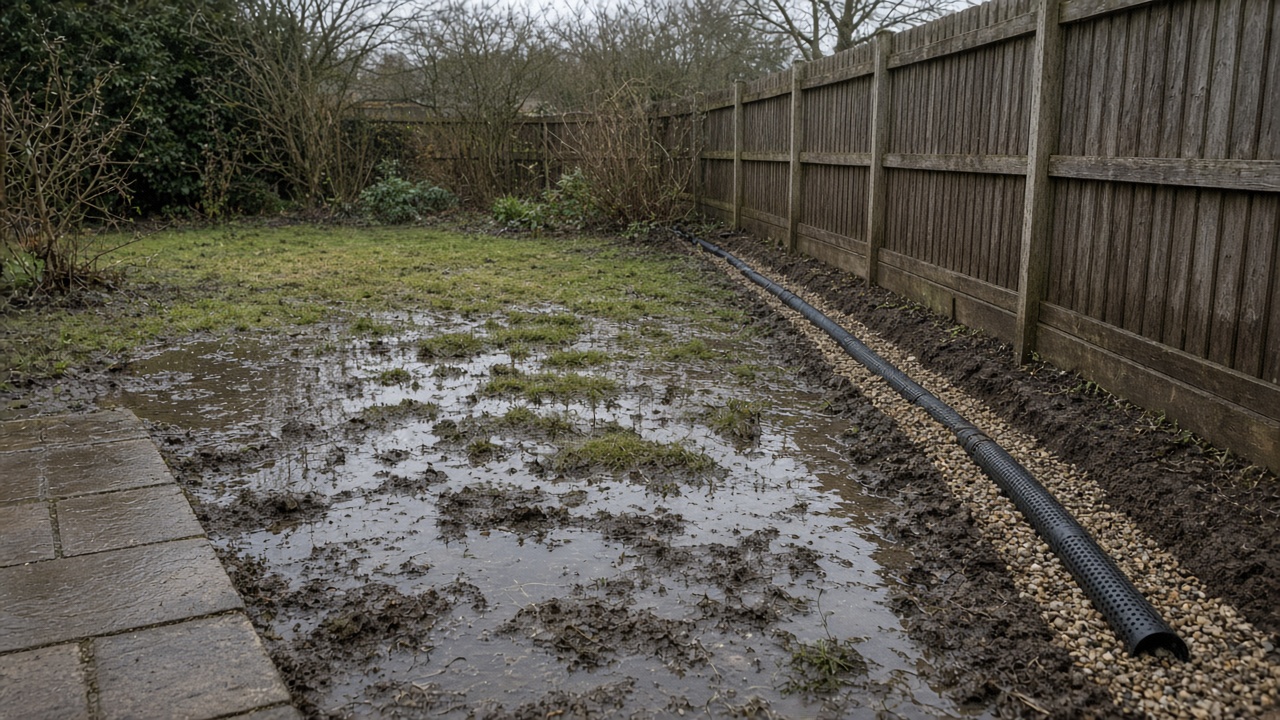
A French drain is a gravel-filled trench around a perforated pipe. It intercepts surface runoff and sub-surface water along its length and carries that water to a discharge point.
The Hertfordshire Clay Problem and Approved Document H
Building Regulations set an order of priority for rainwater: it should go to a soakaway or other infiltration system first, then a watercourse, and only then a sewer. So a soakaway is the preferred first choice, but Building Control wants proof the ground can absorb the water. That proof is a percolation test, and larger soakaways are designed to BRE Digest 365.
Chalk and gravel do sit under the topsoil in parts of the Chilterns, including toward Harpenden and Berkhamsted. Much of Watford and south-west Hertfordshire sits on dense clay. The British Geological Survey says the clays most prone to shrinking and swelling are found mainly in the south-east of Britain. If the test fails, burying crates in that clay is not an option. They fill in the first heavy rainfall and stay full, and the lawn floods again.
Which System Should You Choose?
Choose a soakaway if a percolation test shows the plot can take the volume, and the crates can sit well away from the house. Approved Document H says infiltration devices should not be built within 5m of a building or road, or where the water table reaches the bottom of the device at any time of year.
Choose a French drain if the ground fails the test, water is pooling on the lawn, patio or along the walls, and you have an approved outlet. In clay that outlet is a ditch, a watercourse, or an existing surface-water drain, with water-company consent where it is required. It must never be connected to a foul sewer: the rules exist to keep rainwater out of the public foul sewer, which it can overload and cause flooding. Rainwater should not go into a septic tank or cesspool either.
A Deeper Pit Only Works If the Test Finds a Permeable Layer
Where the upper soil is clay but a deeper layer is permeable, a French drain can collect the surface water and feed a soakaway that reaches that lower seam. A deeper or larger hole in the same clay does nothing. If the clay does not drain, a bigger box holds more stagnant water.
Runoff from land drains should pass through a silt trap before it reaches a soakaway or a surface-water line. The trap settles soil, leaves and grit so the pipe and the geotextile do not clog.
Getting the Right System for Your Home
The first step on a waterlogged garden is a soil inspection and a percolation test, so you know whether the water can soak away or has to leave the site. New drain installations cover soakaways and surface-water drains, and our guide to whether rainwater goes into the sewer explains how your existing drains are likely to be laid out.
If water is backing up out of a gully, or a manhole is full to the cover, that is a blocked drain, not a garden drainage design. That job is drain unblocking. Call 01923 959780 for a fixed price.
Common Questions
Does a Soakaway Work in Hertfordshire Clay?
Only where a BRE Digest 365 percolation test shows the ground can take the water. Much of Watford and south-west Hertfordshire is dense clay, so the crates fill in the first storm and stay full. Chalk or gravel under the topsoil, more common toward Harpenden and Berkhamsted, can pass the test.
Can a French Drain Connect to the Foul Sewer?
No. A French drain in clay must discharge to a ditch, a watercourse, or a surface-water drain, with consent where the water company requires it. Connecting surface water to the foul sewer is not allowed.
Need an Engineer?
Call for a fixed price, or leave your details and we will call you back. The phone is answered 24 hours a day.